SAVERS · Evacuation Guidance for Disaster-Vulnerable Residents
Team Lead · PM · Evaluation & Infra (team of 4) · K-Digital Training Hackathon 2026 · FastAPI, LangChain, OSMnx, NetworkX, AWS EC2, FCM
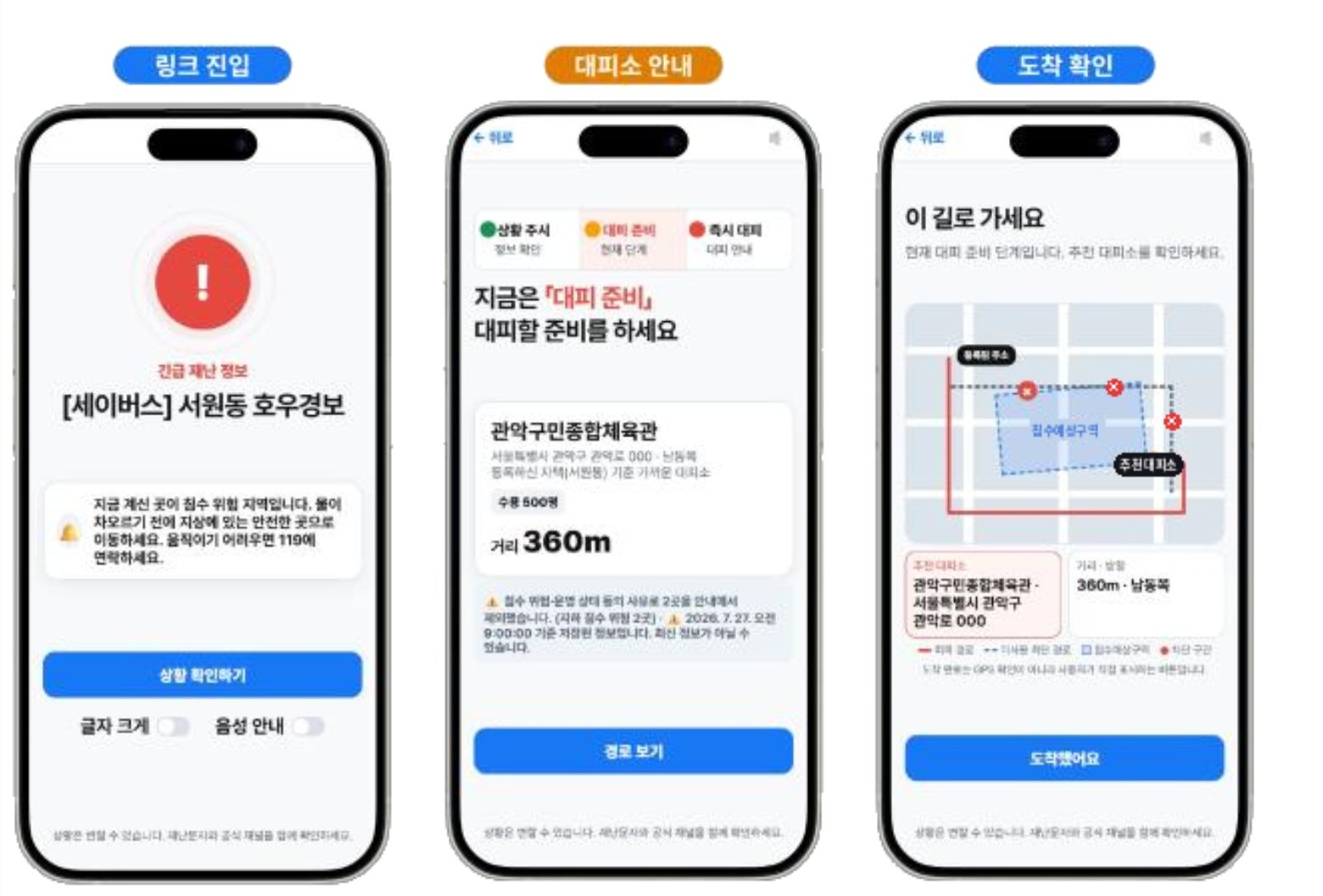
- Problem: official flood alerts send the same text to everyone, but residents who cannot judge or evacuate alone need personal guidance, with no app install and no constant location tracking.
- Contributions: owned the evaluation code (a 40-case golden set of 35 answer and 5 refusal cases, 12 adversarial regressions, a 34-case refusal probe, the scoring scripts) and the infrastructure code (real FCM sending, AWS deployment, CI); kept the decision records (ADRs); first-authored the paper.
- Shelter choice and walking routes are computed by rule-based code (OSMnx / NetworkX), not the LLM; the LLM only explains results that are already fixed.
- The verifier splits each answer into claims and checks them against the event log, with a pass bar of zero unsupported claims. Feeding pre-written answers straight into scoring, it wrongly blocked 0 of 35 correct answers; only 8 of 12 adversarial answers were caught at first, and after I analyzed the 4 misses and closed the gap, 12/12. Of the 40 golden cases, 30 were finalized by adopting the system’s output and then checking it against the contract documents.
- Tested refusal in both directions on the chatbot path (offline stub generator at the time): wrongly refused only 1 of 28 valid questions (3.6%), but answered all 6 out-of-scope questions from unrelated evidence (6/6 under-refusal), a failure grounding scores miss; traced it to retrieval, not the verifier.
- User study (n = 52, acquaintances, within-subject): action clarity 3.2 → 8.3 out of 10 (Wilcoxon p<0.001); "would leave within 5 minutes" 13% → 60%.
- Minister of Employment and Labor Award (3rd of 326 teams); first-author oral presentation at ACK 2026.
- Limitation: the generator was an offline stub that copies evidence sentences at measurement time; the numbers must be re-measured with a real model.